




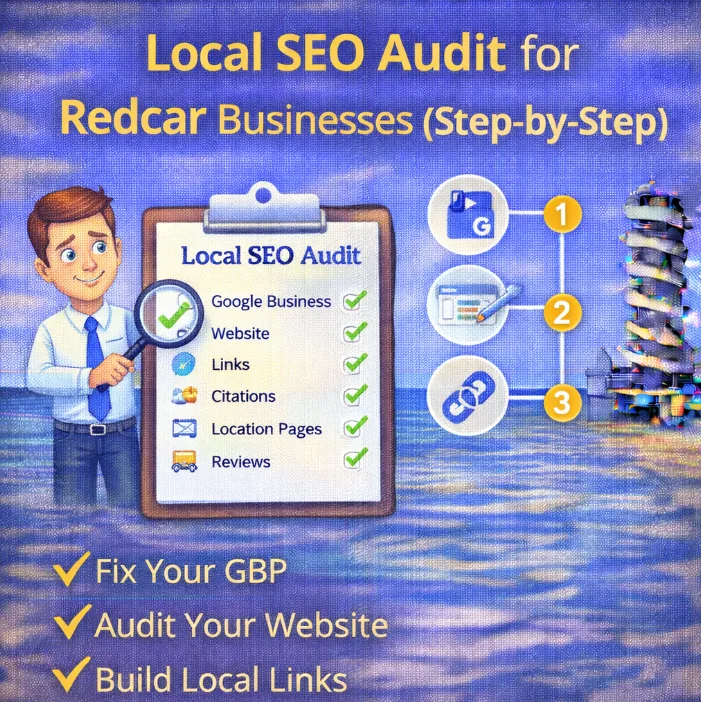
Let’s be honest for a moment. If you are running a business here in Redcar, whether you are selling lemon tops on the seafront or fixing boilers in Dormanstown, you know the competition is fierce. You might have the best product or service in the Teesside area, but if Google doesn’t know you exist, neither do your customers.
That is where a local SEO audit comes in.
Think of an audit like an MOT for your website and digital presence. You wouldn’t drive a car around Redcar with a rattling engine and flat tyres, so why let your business chug along with broken links and a messy Google Business Profile? A proper audit lifts the bonnet on your online marketing, showing you exactly why you aren’t ranking and, more importantly, how to fix it.
In this guide, we are going to walk through a comprehensive, step-by-step audit designed specifically for Redcar business owners. We are going to strip back the jargon and focus on what actually moves the needle. By the end of this, you will have a clear roadmap to dominating the local search results.
Phase 1: The Google Business Profile (GBP) Deep Dive
Your Google Business Profile is arguably the most critical piece of the puzzle for local visibility. If you aren’t showing up in the “Map Pack” (those top three listings with the map), you are leaving money on the table.
1. Is Your NAP Consistent?
NAP stands for Name, Address, and Phone Number. It sounds simple, but you would be amazed how many businesses get this wrong. Google wants to trust that you are who you say you are. If your Facebook page says you are at “123 High Street, Redcar” but your website says “123 High St, Coatham,” Google gets confused. And when Google gets confused, it drops your rankings.
Check your NAP consistency across:
- Your GBP listing
- Your website footer
- Social media profiles
- Local directories (Yell, Scoot, etc.)
2. Are Your Categories Spot On?
One of the biggest reasons for why your GBP is not getting calls is incorrect categorisation. You have a primary category and secondary categories. Be specific. If you are a “Pizza Restaurant,” don’t just put “Restaurant.”
Take a look at your GBP categories. Are you using all the relevant secondary categories? If you are a landscaper who also does tree surgery, make sure both are listed. This helps Google match you to a wider variety of search queries.
3. The Review Reality Check
Reviews are social proof. We all read them. If your competitor in Marske has 50 five-star reviews and you have three reviews from 2018, guess who gets the click?
Audit your review strategy:
- Quantity: Do you have a steady stream of new reviews?
- Quality: Are you getting 4 and 5 stars?
- Response: Are you replying to every review? Even the bad ones? Responding shows potential customers that you are active and you care. It also signals to Google that the business is managed properly.
4. Products vs Services
There is often confusion here. Google allows you to list both. If you sell physical items, use the Products tab. If you are a service provider, like a plumber or accountant, use the Services tab.
However, the Products vs Services debate is interesting because “Products” often display more prominently on your profile with images. Even if you sell a “service” like “Boiler Repair,” you can sometimes list it as a product to grab more visual real estate on the screen.
5. Check Your Description
Does your GBP description actually sell your business? You have 750 characters. Don’t just stuff it with keywords. Write a compelling pitch that tells people in Redcar why they should choose you. Mention your history in the area, your specific expertise, and what makes you different.
Phase 2: On-Page SEO Essentials
Now we move to your actual website. This is your digital storefront. If the shelves are messy and the lights are off, people will walk straight back out.
6. Title Tags and Meta Descriptions
These are the snippets of text that appear in the search results (SERPs).
- Title Tags: This is the blue clickable headline. Does it include your main service and your location? Ideally, it should look something like: Emergency Plumber Redcar | 24/7 Boiler Repairs | [Business Name]
- Meta Descriptions: This is the text underneath. It doesn’t directly impact rankings, but it massively impacts click-through rates. Treat it like a mini-ad. If yours is blank, Google will just pull random text from your page, which looks messy.
7. Keyword Research and Placement
Are you targeting the keywords people actually type into Google? You might call yourself a “harbinger of clean garments,” but your customers are searching for “Dry Cleaners Redcar.”
Conduct proper keyword research to find out what volume of searches different terms get. Once you have your list, check your keyword placement. Your primary keyword should appear in:
- The H1 header
- The first 100 words of the content
- Naturally throughout the body text
- Image Alt text
But be careful. Keyword cannibalisation is a real issue. This happens when two pages on your site are fighting for the same keyword. If you have five different pages all trying to rank for “Redcar Builder,” you are confusing Google. Pick one champion page for each topic.
8. Content Quality and Local Focus
Content is king, but context is queen. Is your content genuinely useful? Google looks for E-E-A-T (Experience, Expertise, Authoritativeness, and Trustworthiness).
If you are writing local SEO content, it needs to speak to the local area. Don’t just write generic advice. Mention local landmarks, local problems (e.g., “How the sea air in Redcar affects your windows”), and local solutions. This helps build topical authority and proves to Google that you are truly a local expert.
9. Service Pages Structure
Look at your service pages. Do you have a dedicated page for every distinct service you offer? If you offer roofing, guttering, and fascia repairs, don’t lump them all on one “Services” page. Create a specific page for each. This allows you to target specific keywords for each service and rank for more terms.
10. Internal Linking
This is often overlooked. Internal linking connects your pages together, allowing Google’s bots to crawl your site easily and understand the relationship between pages.
If you write a blog post about “Winter Car Maintenance,” you should link it to your “Car Servicing” page. Use descriptive anchor text—don’t just link the words “click here.” Link the words “car servicing in Redcar.”
Phase 3: Technical Health Check
You don’t need to be a coder to check the basics, but technical issues can tank your rankings faster than anything else.
11. Mobile Friendliness
More than half of all searches happen on mobile. If your website looks like a tiny desktop version on a phone, you have lost the customer. Google uses mobile-first indexing, meaning it looks at your mobile site first to decide where to rank you. Check your site on your phone right now. Is the text readable? are the buttons clickable?
12. Page Speed
We are all impatient. If your site takes 5 seconds to load, that potential customer has already clicked back and gone to your competitor. Large images are usually the culprit.
13. URL Structure and Breadcrumbs
Is your URL structure clean?
- Good: domain.com/services/plumbing
- Bad: domain.com/index.php?id=452&cat=9
Also, check for breadcrumbs. These are the little navigation trails at the top of a page (e.g., Home > Services > Plumbing). They help users navigate and help Google understand your site hierarchy.
14. Duplicate Content
Google hates reading the same thing twice. Duplicate content can occur if you have multiple versions of your site (http vs https) or if you copy-paste service descriptions across multiple pages. Each page needs to be unique.
15. Header Tags
Are you using header tags (H1, H2, H3) correctly? You should have only one H1 per page (usually the title). The H2s should break up the main sections, and H3s should be subsections. This hierarchy helps screen readers and search engines understand the structure of your content.
Phase 4: Off-Page Authority
This is what happens away from your website. It’s all about reputation and trust.
16. Local Citations
Local citations are mentions of your business name and address on other websites. We are talking about Yell, Thomson Local, Yelp, and industry-specific directories.
Audit your citations:
- Are you listed on the major platforms?
- Is the information accurate (remember NAP consistency)?
- Are there duplicates?
17. The Backlink Profile
Backlinks are votes of confidence from other websites. If a local newspaper or a relevant industry blog links to you, Google sees that as a stamp of approval.
However, not all links are good. Check for spammy links from dodgy websites. You want high-quality, relevant local SEO links. For example, if you sponsor a local football team in Redcar and they link to you, that is gold.
You can also look into guest posting on relevant blogs or using services like HARO (Help A Reporter Out) to get high-authority links.
Phase 5: Assessing the Competition
You don’t operate in a vacuum. To win, you need to be better than the guy down the road.
18. Who is Dominating the SERPs?
Search for your main keywords. Who comes up first? Look at the SERPs (Search Engine Results Pages).
- What are they doing that you aren’t?
- Do they have more reviews?
- Is their content longer and more detailed?
- Do they have better photos?
This isn’t about copying; it’s about benchmarking. If the top-ranking plumber in Redcar has a 2,000-word guide on boiler maintenance, a 500-word page probably won’t cut it.
Phase 6: Service Area and Location Pages
19. Defining Your Territory
If you are a service-area business (like a mobile mechanic), you need to define your service area in local SEO settings on your GBP. Don’t go crazy and list the whole of the UK if you only work in Teesside. Stick to where you actually travel.
20. Location Pages
If you serve Redcar, Marske, Saltburn, and Guisborough, consider creating specific location pages for local SEO. A page specifically targeting “Accountant in Saltburn” will rank much easier for that term than a generic home page. But—and this is big—do not just copy and paste the text and swap the town name. That is a fast track to a duplicate content penalty. You need unique localised content for each page.
Phase 7: Tracking and Analysis
An audit is useless if you don’t track your progress after you make changes.
21. Setting Up Tracking
You need to track GBP performance and website analytics.
- Google Search Console: Tells you what keywords you are ranking for and if there are technical errors.
- Google Analytics: Tells you who is visiting your site and what they are doing.
- GBP Insights: Tells you how many people called you or asked for directions.
22. PPC vs SEO
Sometimes, an audit reveals that SEO is going to take time – and how long local SEO takes can vary from a few months to a year. If you need leads now, you might want to look at Google Ads. It’s not an either/or situation. PPC vs SEO works best when they are used together. Ads get you immediate visibility while you build your organic rankings in the background.
Common Red Flags to Watch Out For
During your audit, keep an eye out for these specific issues:
- 301 Redirects: If you have changed URLs in the past, ensure you have redirects in place so users don’t hit a 404 error page.
- Canonical Tags: These tell Google which version of a page is the “master” copy, preventing duplicate content issues.
- Missing Physical Address: If you hide your address on GBP but you have a shop front, you won’t rank as a physical store.
- Search Intent Mismatch: Are you trying to sell something on a page where users are just looking for information? Understanding search intent is crucial.
Summary
Conducting a local SEO audit for your Redcar business isn’t just a box-ticking exercise. It is the foundation of your digital growth. By systematically working through your Google Business Profile, on-page content, technical health, and off-page authority, you are building a machine that generates leads while you sleep.
It might seem like a lot of work, and let’s be real, it is.
But the payoff is a business that stands out in Redcar, dominates the local market, and keeps the phone ringing.
So, grab a brew, open up your website, and start auditing. Your future rankings depend on it.
