




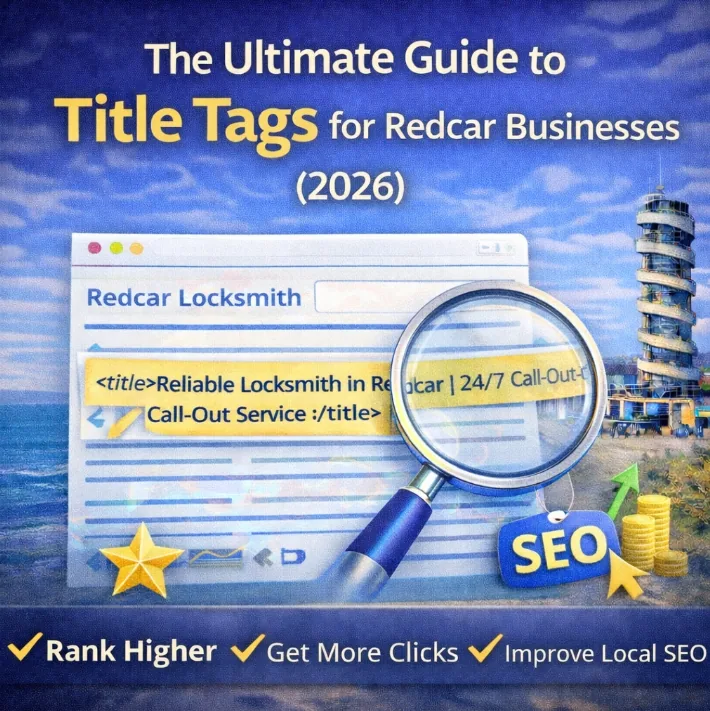
Most local business owners in Redcar simply slap their company name into the title tag and call it a day.
But a weak title is the number one reason your website isn’t getting clicked, even if you are ranking on Page 1.
In this guide, I’ll show you how to write specific title tags that grab attention, match what your customers are looking for, and double your traffic (and enquiries) without touching anything else on your site.
Ready? Let’s get stuck in.
What Exactly is a Title Tag?
As the name suggests, an HTML title tag is a snippet of code on your website that tells the world what your page is named.
It is often used to let both search engines and humans know what a page is about, and strictly speaking, you can only have one of them per page.
It will appear in your source code like this:
<head><title>Best Sourdough Bakery in Redcar | The Loaf Shack</title></head>
Don’t worry about the code for now. If you are using WordPress, plugins will handle the technical heavy lifting for you.
As long as you remember that the tag fits within the HTML of your website and there is a limit of one per page, you’ll be grand.
The title tag shows up in these 4 distinct places:
1. Web Browser Tabs
If you look at the top of your screen right now, on this very tab, you should see a description of what you are reading.
The importance of this is that it helps the user figure out what is on the tabs they have open. It needs to be designed so that users can immediately understand what you offer.
2. Browser Bookmarks
Browser bookmarks show the page title tag by default unless a user renames the saved web page.
These generally get cut short due to the way the bookmarking bar is set up. However, you do get long versions of the bookmark title when looking within folders.
Because of this truncation, ensure you have short, snappy, but identifiable tags.
3. When You Share On Socials
If you have ever seen anything shared on Facebook or Twitter, the title of the page is usually shown in the little header section of the link preview.
This helps to let people know what the main content is about before they commit to clicking through to your site.
4. Title Tags in SERPs
One of the most important places, and the one you really should care about, is on the SERPs (Search Engine Results Pages).
It is the big, blue clickable link above the short description.
If someone searches for a service related to your local business, this is the very first (and potentially last) time you will get to convince them to click your website.
It could mean the difference between a fully booked diary and tumbleweeds blowing through your shop.
Why Are Title Tags Vital for SEO?
Don’t listen to the noise about title tags being irrelevant in 2026.
While they may not carry the same weight as they did decades ago, title tags are a low effort, important aspect of dominating the local search results.
With the right knowledge, you could easily double your traffic in a matter of a week.
Now, imagine how much more revenue that could mean for your business?
Here are the benefits of optimising your tags:
1. Keyword Rankings
So, do you need to put your keywords in the title tag to rank well on Google?
The quick answer: YES.
It comes down to a simple question: why wouldn’t you?
Even if it only had a 1% increase on your traffic, it is not that difficult to type your main service into your title tag.
I have never skipped this step, and I never plan on skipping it in the future. So yes, add your keyword into your title, and get yourself some more local leads.
2. Click Through Rate (CTR)
I have already touched on this, but you can really make the most of your titles if you start to optimise for CTR.
Now, is CTR a ranking factor?
Nothing has been confirmed, but ask yourself this:
“If people don’t like your website enough to click it, why would Google keep ranking you?”
Your main goal with ranking is not the ranking number itself; rather, it is the amount of traffic you generate. Having a great CTR infused title will help you get more out of your top ranking positions.
Imagine you rank number 1 for ‘Florist Redcar’ which has a total of 1000 searches per month.
And now imagine that this is your title:
“Florist in Redcar”
Do you think you are getting all the traffic you possibly could?
Of course not. Why? Because your title isn’t attractive enough.
Well, if you changed your title to something like: “Luxury Florist in Redcar | Same Day Delivery”
This could easily double your traffic.
3. Headlines Are Your Only Chance
Your title tag is the first and potentially only thing a searcher may ever see about you or your business.
So you need to optimise it.
Let me reposition title tags as this: it is just a headline.
Imagine the headlines you have read in the local paper. Most of the time, you read the title, see that something happened on the Esplanade, and you move on with your day, right?
Well, your fellow internet users are no different.
Most users will read the headline only and move on too.
This same logic applies to your website when it pops up on the results page. If you don’t hook them, your engagement will go down, which will cause you to be budged down the rankings over time.
Common Questions About Title Tags
Now you know the importance of a good tag, I want to cover some frequently asked questions on the matter.
Does Google Rewrite Titles?
Yes.
Google almost always reserves the right to rewrite titles. They couldn’t provide useful results to their users if they quit rewriting titles that are poorly written or irrelevant.
If Google doesn’t think your tag is relevant to what the user is searching for, is readable, or provides value, then it will rewrite it for you.
Generally, I still find this aspect of the Google algorithm to be quite frustrating, even though they are trying their best.
But remember that their system is only going to flag your title to be rewritten if it doesn’t match the page content. You are actually in control if you take a few minutes to craft a helpful and engaging tag.
So instead of having a title tag like: “Carpet Cleaner Redcar”
Have something like: “Expert Carpet Cleaner in Redcar – Stubborn Stain Removal”
This is way more helpful and has a much better chance of getting the click.
How Long Should Your Title Be?
It can be as long as you want it to be.
BUT.
Search engines typically only show a maximum of 60 characters, so a lot of that title is going to be cut off if you go over.
If your title does cut off, it also increases the likelihood that Google will rewrite it.
The 60 character limit is a slight lie too, as it is more or less about a 600px limit. This is because characters like ‘M’ and ‘W’ take up much more space than ‘I’ or ‘J’.
Can Your Title Tag and H1 Be The Same?
The short answer is yes, they can be.
You want to keep them as consistent as you can to not cause confusion for the search engine and its searchers.
Generally, I like to make sure my title tag and my header tags include the keyword.
While my title tag has more of a “click me” design to it, my H1 just tells the user exactly what they are getting without as much sales pressure. This is down to the fact that when people see the H1, they are already on the site, so they tend not to need that extra nudge.
Does Every Page Need a Unique Title Tag?
Yes, every page should have a unique title tag that accurately describes its content.
Duplicate content is one of the mega issues in SEO.
If anything from pages to titles to content is duplicated, it can negatively affect your website massively.
This will make your website come across as spammy or low quality, which will destroy your SEO rankings.
So yes, keep your title tags unique.
Should You Include Your Brand Name?
This depends. For service pages, yes. For long form blogs, no.
Including your brand name helps establish authority.
People have seen your shop front or your van around town, so they already recognise your brand, even if just a little. When they see your site in the search results, that familiarity makes them more likely to click on you over a competitor.
When it comes to blog posts, your title should focus on the keyword and the context. It usually doesn’t leave space for your brand name.
People reading your blog don’t know who you are yet, and honestly, they don’t care. They are not here to buy from you right now; they are just looking for answers.
Can I Use Emojis?
Yes, you technically can use them, but I would avoid it.
Emojis can come across as looking spammy or too loud when shown to a user.
Just as much as Google hates full caps on your titles, I suspect that titles with emojis will get rewritten, or simply make you look like a clickbait social media influencer rather than a serious local business.
Google says it is okay, but don’t risk it for your reputation.
How Often Should You Update Them?
In an ideal world, you would constantly be tweaking your title tags.
With the right CTR focused titles, you can squeeze the most out of your top ranking spots. In theory, you would be testing new titles every few weeks.
But in reality, this takes a lot of time. And most of the time, there are far more valuable things to work on.
That said, if you have content with the year in the title, it does make sense to go back and update it.
18 Ways to Optimise Your Title Tags
Here are 18 ways to optimise your tags so you can boost your traffic by next week.
1. Focus On Content First
A weird one to start on I am sure, but hear me out.
It doesn’t matter how amazingly optimised your title tag is; if you have terrible local SEO content, you are simply not going to rank.
And even if you do, your readers will be bouncing off your page fast. Provide as much value as possible first, and then worry about your title tags.
2. Identify The Page Type
How you craft your title heavily depends on the type of page it is.
Each page on your website serves a different purpose, so it attracts a different audience.
- Homepages: If you are a landscape gardener in Redcar, your home page will likely rank for ‘landscape gardener Redcar’. You want to include “Contact Now” or “Get a Quote” in the title tag, as well as your brand name.
- Local Pages: I have found that a lot of companies just place their local keyword at the beginning of the title and then have some sort of CTA attached to the end. And this works perfectly. For service pages, stick to “[Local Keyword] + CTA + Brand Name”.
- Blog Posts: You want to make the title as accurate as possible while still being interesting and including your keyword.
3. Meet Search Intent
There are four primary categories of search intent:
- Informational: “Do I need planning permission for a conservatory?”
- Comparison: “Hardwood vs Laminate flooring.”
- Transactional: “Buy red roses Redcar.”
- Navigational: Searching for your specific brand name.
All keyword phrases that you will target fall under one or more of these categories. It is your job to understand which one and make it as clear as possible for the searcher that you have the best page for them.
4. Front-Load Your Primary Keyword
With your new knowledge of search intent, it makes sense that you will place your chosen keyword at the beginning of the title.
This ensures a searcher can immediately spot that your website is for them and will answer whatever it is they are searching for.
Your keyword placement doesn’t always have to be at the very start of your title, but towards the front will be enough to catch the eye.
5. No Keyword Stuffing
You want to put your keyword in your title tag, no doubt about it.
But you don’t need to use those 60 characters to fill it to the brim with variations.
Google has evolved. It can now understand what you are trying to rank for based on your website content, so there is no need to overdo it.
Searchers have gotten better at sniffing it out too. You may be turning them away unknowingly as you can appear to be robotic to them.
Trying to target multiple keywords in a single title usually ends up watering everything down. You confuse both Google and your readers, and risk keyword cannibalisation where your pages fight against each other.
6. Shorter Titles Are Best
Short and sweet is always the aim when it comes to writing copy.
If you want to keep your title under 60 characters, avoid capital letters where they aren’t needed as they take up more space, avoid using punctuation when necessary, and use short punchy phrases.
7. Avoid Duplicating Page Titles
The bottom line is that nothing on your website should be the same.
Even if you have similar pages for a good reason, you want to make sure that you add a level of uniqueness which will stop Google from punishing your site.
Make sure you craft unique page titles for every page.
8. Use Power Words
One of the easiest ways to get higher CTRs is to use power words. These are words that just give your title that little bit of a boost, making it a lot more click worthy.
Think words like: Expert, Certified, Proven, Guaranteed, Vetted, Fast, Instant, Premium.
9. Inject Freshness
Nobody likes outdated content, especially when they are looking for current regulations or prices.
Simply highlighting that something is recent can be a major driver of clicks.
If you are writing a guide, try weaving in freshness cues like “Updated for 2026” or “New Prices”.
10. Use the H & W Strategy
The H & W strategy is a simple but effective way to create engaging title tags.
Just start your title with one of these words: How, What, Why, When, Where, or Who.
These types of titles work because they match common search queries and spark curiosity.
For example: “How to Remove Red Wine From Carpet” or “Where to Find the Best Pies in Redcar”.
11. Use Numbers
Lists still perform quite well to this day.
You don’t need to change every page on your website to a list, but start utilising numbers more in your blog titles.
Use numbered lists (7 Tips for…), monetary figures (How we saved a client £500), or percentages (Cut energy bills by 20%).
12. Use Curiosity Driven Titles
The classic clickbait style headline works because it taps into human curiosity.
The trick is to give readers a sneak peek into what they will learn without giving too much away.
Use engaging language that evokes surprise or urgency. But do not overdo it, or you will look spammy.
13. FOMO is Your Friend
Everyone gets Fear Of Missing Out from time to time.
You can use titles like “Ultimate Guide” or “Don’t Miss Out” to tap into this. But again, be careful with aggressive styles.
14. Emphasise Speed
One of the most effective sales tactics is showing people how much time they will save.
Make it crystal clear how fast you can get the job done, whether it is “Same Day Delivery” for flowers or “1 Hour Response” for emergency plumbing.
15. Pattern Interrupts
You can stand out in the search results by using eye catching symbols.
Incorporating brackets, curly brackets, or equals signs can catch your audience off guard and keep them hooked on your website line after line over your competitors.
16. Incorporate Everything You Know
There is no one tactic that trumps all when it comes to crafting the perfect optimised title tag.
You want to mix and match the previous methods, and eventually, you will find what gets you the most traffic.
17. Testing
You can use tools to track how well your pages are performing. Look for pages with solid rankings but a weak click through rate.
These are prime candidates for a title refresh. Create variations, update the tag, and wait a few weeks to see if your local SEO audit shows an improvement.
18. Be Realistic
Every method in this guide will help you optimise your title tags for better SEO.
But let’s be real, a well optimised title tag alone won’t skyrocket your rankings.
Think of it as a small but important piece of the puzzle. Placing your keyword in the title is the bare minimum. But when combined with local SEO ranking factors like great content and solid backlinks, that is when the magic happens.
Closing Thoughts
SEO is often a combination of small, impactful actions working together to achieve remarkable results.
While optimising title tags might seem like a minor step, it plays a vital role in your overall strategy to improve local visibility and attract the audience you want.
Remember, success in SEO doesn’t happen overnight – it’s a process that requires consistency, attention to detail, and a focus on what works for your unique business.
By taking actionable steps and refining your approach, you’ll be well on your way to boosting your website’s rankings and driving real growth for your business in Redcar. Keep optimising, stay patient, and watch your efforts pay off.
