




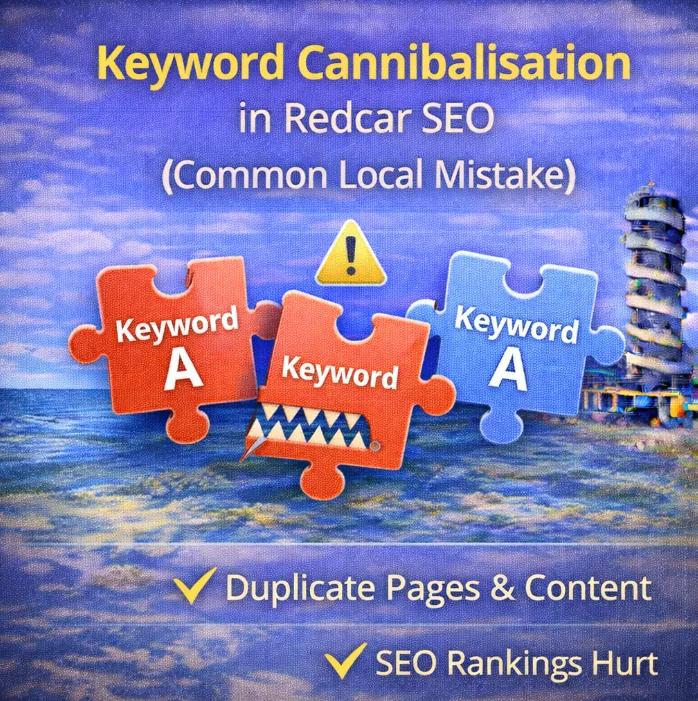
Keyword cannibalisation is one of the most common issues I see on local business websites in Redcar and across Teesside.
It usually isn’t intentional.
It usually isn’t obvious.
And it usually holds sites back quietly.
Pages get published over time. Service pages expand. Locations get added. Blog posts pile up.
Eventually, multiple pages start chasing the same keywords.
That’s when a site starts competing with itself.
What Keyword Cannibalisation Actually Means
Keyword cannibalisation happens when two or more pages on the same website target the same keyword or the same search intent.
For a Redcar business, that might look like:
- a service page targeting “accountant in Redcar”
- a blog post also optimised around “accountant in Redcar”
- a location page added later with similar wording
Each page sends a similar signal.
Instead of one clear answer, Google sees several overlapping ones.
The result is usually unstable rankings, the wrong page appearing in SERPs, or pages swapping positions without gaining ground.
This isn’t about Google being broken.
It’s about Google being forced to choose.
Why Cannibalisation Is a Problem for Local Redcar SEO
Local SEO relies on clarity.
When pages overlap, several things get split:
- relevance
- internal link strength
- backlinks
- user engagement
Instead of building authority around one strong page, that authority gets diluted.
This is especially damaging for Redcar businesses because local search volumes are smaller. You don’t have room to waste signals across multiple URLs.
One strong page beats three weak ones every time.
How to Check for Keyword Cannibalisation (Quickly)
You can spot most cannibalisation issues with a simple Google search.
Use: site:yourwebsite.com “your target keyword”
Example for a Redcar business: site:examplebusiness.co.uk “redcar accountant”
If multiple pages appear, open them and check intent.
Ask yourself one question:
Would a customer see these pages as meaningfully different?
If the answer is no, Google won’t see the difference either.
How to Fix Keyword Cannibalisation Properly
Fixing cannibalisation is about making a decision, not adding more content.
Consolidate Where Intent Is the Same
If two pages serve the same purpose, combine them.
Take the strongest content from both.
Create one clear page.
301 redirect the weaker URL into the main one.
This concentrates relevance and usually produces quick improvements.
Differentiate Pages by Intent
If both pages need to exist, they need different jobs.
For example: Main page: “Mortgage Advice in Redcar”
Supporting page: “First-Time Buyer Mortgages in Redcar”
That difference should be reflected in:
- header tags
- copy
- internal links
- calls to action
If intent isn’t clear in the content, Google won’t infer it.
Canonical Tags (Edge Cases Only)
Canonical tags can help when pages must exist for technical or legal reasons.
For most Redcar business websites, consolidation or repositioning is the better option.
Canonicals are a tool, not a default fix.
Why This Happens So Often on Redcar Business Sites
This problem isn’t caused by bad SEO.
It’s caused by unplanned growth.
Pages get added reactively:
- a new service
- a new location
- a blog answering a common question
Each page makes sense on its own. Over time, overlap creeps in.
This is common on DIY SEO sites and even on sites built by agencies that don’t map keywords before publishing.
How to Prevent Cannibalisation Going Forward
Assign One Primary Keyword Per Page
Every page should have a single main target.
Supporting keywords are fine. Overlapping primary targets are not.
If two pages are meant to rank for the same thing, one of them shouldn’t exist in its current form.
Build a Simple Keyword Map
A keyword map doesn’t need to be complicated.
For each page, note:
- the primary keyword
- the search intent
- the role of the page
This turns content creation into a system rather than guesswork.
Use Content Clusters Instead of Duplicates
You can cover a topic deeply without competing with yourself by using content pillars.
Example for a Redcar business:
Pillar page: “SEO Services in Redcar”
Supporting pages:
- “How Redcar Businesses Get Found on Google”
- “Local SEO vs Google Ads for Small Businesses”
- “Common SEO Mistakes Redcar Businesses Make”
Each page supports the main topic without targeting the same query.
That’s structure. Not cannibalisation.
Final Thoughts
Keyword cannibalisation doesn’t break a site overnight.
It slows everything down.
Rankings stall. Pages underperform. Effort gets spread thin.The fix is clarity.
For Redcar businesses competing in tight local markets, that clarity is often the difference between page one and page two.
