




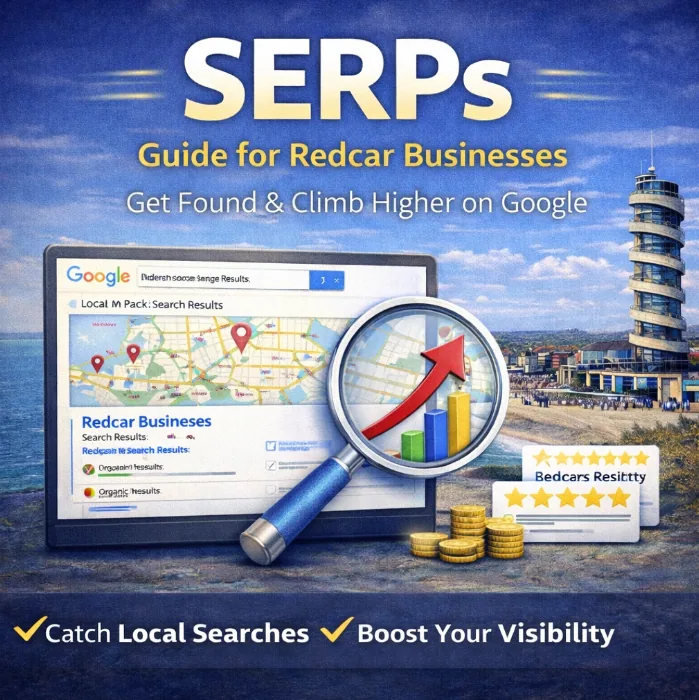
You’ve probably heard the term SERPs thrown around in marketing meetings or online forums like it’s the holy grail of digital success.
“We need to dominate the SERPs!”
“How do we climb the SERPs?”
“Our competitors are crushing us in the SERPs!”
That’s all well and good. But…
WHAT ACTUALLY ARE SERPs?
If you run a local business in Redcar
Whether you’re a baker on the High Street, an accountant near the seafront, or a mechanic in Dormanstown
This is one concept you need to fully grasp to get found online.
Let’s dive in:
Defining the SERP
SERP stands for Search Engine Results Page.
It’s just the technical term for the page that pops up after you type something into Google.
Type in:
“plumber in Redcar” – boom.
That page full of links and maps? That is the SERP.
It is the digital battlefield where the war for attention, clicks, and customers takes place.
At the very top, you’ll usually see Google Ads, followed by map results (your Google Business Profile), and then the organic listings (like your website or blog posts).
Each one of those spots is a piece of prime digital real estate.
And here is the harsh truth:
If you are not on that page – you effectively don’t exist.
It doesn’t matter how tasty your cakes are, how fast you fix cars, or how many years you’ve been trading. If Google doesn’t show you on the SERP, potential customers won’t see you either.
This is where SEO earns its keep – it is how you claim your spot in the search results and start getting found by locals.
Breaking Down the Modern SERP
The Google results page isn’t what it used to be. It’s no longer just “10 blue links and good luck.”
Today’s SERP is packed with features – and each one is a chance for your Redcar business to show up and get the click.
Let’s break down what you might see when someone Googles something like “best coffee shop in Redcar” – and what it means for you:
1. Paid Advertising Slots
These live right at the top, usually marked with “Sponsored” or “Ad.”
This is the pay-to-play section. You tell Google, “Hey, I’ll pay if someone clicks my ad when they search ‘accountant in Redcar’.”
If your ad is relevant, and your landing page delivers, you can be at the front of the queue getting calls instantly.
AS LONG as you keep handing over cash to Google.
The catch? You pay every time someone clicks. It doesn’t matter if they buy from you or immediately hit the back button. It’s great for quick wins, but often expensive for a long-term strategy compared to organic growth.
2. The Local Map Pack
This is the holy grail for local businesses in our area.
You have seen it – that box with 3 local businesses, showing names, reviews, addresses, and a “Call” button.
It is the first thing most people click when they search for local terms. Google is basically saying: “Here are the most trusted options closest to you.”
If you aren’t in that 3-pack? You are missing out on a massive chunk of traffic. About 83% of local intent searches never click the ‘More businesses’ button.
Here is what it takes to show up here:
- Google Business Profile (GBP): If you haven’t set one up, you’re not even in the race.
- Fully Optimised Listing: That means accurate categories, services, opening hours, and gathering GBP reviews consistently.
- Strong Local SEO Signals: Your website needs to back up your GBP using local SEO content and consistent name, address, and phone number details.
This section isn’t just about visibility; it is about trust.
3. Organic Search Results
This is the part of the SERP most people recognise. Those standard blue links that lead to regular websites.
No ads, no map pins. Just the pages Google thinks best answer the search.
This is where your service pages, location pages, and blogs should be showing up.
The best bit? If you rank here, you aren’t paying a penny for those clicks.
But make no mistake – it is not a fluke. You will only earn your place here if a few things are firing properly:
- Your content must match search intent (what the user actually wants).
- Your on-page SEO needs to be solid (think title tags and meta descriptions).
- You need to be the better option than your competitors.
If you rank here, you are credible. And that is how Redcar businesses turn clicks into loyal customers.
4. Featured Snippets
You know that little box at the very top of Google – the one that gives you a straight answer without you even clicking a website? That is a featured snippet.
It might show a paragraph, a list, or a table.
You don’t need to be ranked #1 to win a featured snippet. If your content is clearer and structured better than the page in position one, Google can bump you up into the spotlight.
To win these, focus on clear formatting like bullet points and answering questions directly.
5. AI Overviews (The New Kid on the Block)
Just when we thought we had the SERP figured out, Google started rolling out AI Overviews.
This uses AI to generate summaries from multiple sources across the web to answer a query directly on the results page.
It might quote from your blog posts or guides if it thinks you have the best answer. To stand a chance of appearing here, focus on answering specific questions clearly in your content, like “how much does a will cost in Redcar?”
6. People Also Ask
You have seen these dropdown Q&A boxes. They are loaded with extra questions your potential customers are already asking.
They usually show up under a standard result, and they tell you exactly what your audience wants to know.
Google is literally handing you the questions – all you have to do is answer them better than anyone else in your content. It is free exposure and builds topical authority.
Why Analysing SERPs Matters
The businesses that get leads from Google are the ones that check the SERPs first.
They know what Google wants for every keyword they target because the results page tells them.
If you search for your service and see mostly map packs and directories, you know you need to focus on Local SEO. If you see mostly “how-to” guides, you know you need to write a blog post.
You can stop guessing and start giving Google exactly what it wants.
How to Check Your Own SERPs
You don’t need expensive tools for a quick check.
- Type your target keywords into Google.
- Look at what is actually ranking on page one.
- Ask yourself: Are these blog posts? Homepages? Is there a map pack?
Whatever is showing up – that is what Google thinks users want. So give it to them, just better than what is already there.
Conclusion
You are trying to rank higher, but you might not be looking at the battlefield. That is like trying to bake a cake without a recipe – you are guessing, while your competitors are following a proven formula.
Once you understand SERPs, you stop guessing and start making moves that actually work.
Monitor your progress, track your rankings, and refine your strategy based on what works.
