




If you have been banging your head against a wall trying to get your business to show up on Google, you are not alone. You have likely heard the term “backlinks” thrown around in marketing circles more times than you have had hot dinners. Everyone says you need them. But nobody really explains which ones you need.
Here is the brutal truth. Not all links are created equal.
For a business right here in Redcar, chasing the wrong type of link is like training for a marathon by only doing bicep curls. Sure, you are doing something, but it isn’t going to help you win the race you have actually entered.
In the world of search engines, there is a massive difference between a generic backlink and a hyper-targeted Local SEO link. Understanding this difference is often the “aha!” moment that takes a local florist or a high street bakery from page four of Google to the very top of the Map Pack.
Let’s break down exactly what these links are, why they matter, and how you can get the right ones to dominate the local market.
The Basics: What is a Backlink Anyway?
Before we dive into the specific types, let’s get on the same page about what backlinks actually are.
Think of the internet as a massive popularity contest. Every time another website links to your website, it counts as a “vote.”
Google looks at these votes to decide who deserves to be number one. If a website with a high reputation links to you, Google assumes you must be trustworthy too. It is a concept known as E-E-A-T (Experience, Expertise, Authoritativeness, and Trustworthiness).
However, Google has got smarter. It doesn’t just count the votes; it looks at who is voting.
If you run a dog grooming salon in Marske, a vote (link) from a massive pharmaceutical company in Germany might look impressive on paper, but does it make sense? Not really. But a vote from a local Redcar pet supply shop? That makes perfect sense.
This is where the battle between general backlinks and local SEO links begins.
What Are General Backlinks?
General backlinks are links from websites that have high “authority” but aren’t necessarily tied to a specific geographic location.
These usually come from:
- National news outlets (like The Guardian or BBC).
- High-traffic industry blogs (like a popular global business blog).
- Educational domains (.edu) or government sites (.gov) that aren’t location-specific.
- General business directories that cover the whole UK or the world.
The Purpose of General Backlinks
The main goal of acquiring these links is to build Domain Authority. This is a metric that predicts how well a website will rank on search engine result pages (SERPs).
When you get a general backlink from a giant website, some of their “power” passes to you. It tells Google that your website is legitimate and technically sound.
The Downside for Local Businesses
Here is the catch. While these links are great for building raw power, they often lack relevance.
If you are a plumber in Redcar, ranking for the term “best plumber” globally is useless. You don’t want calls from London or New York. You want calls from Redcar, Saltburn, and Guisborough.
General backlinks boost your overall site strength, but they don’t necessarily tell Google, “Hey, rank this guy for people searching in Redcar.”
What Are Local SEO Links?
This is where the magic happens.
Local SEO links are backlinks from other websites that are specifically relevant to your geographic area. They might not have the massive “authority” scores of a national newspaper, but they have something far more valuable for you: Local Relevance.
These links act as a signal to Google that you are a genuine part of the local community. They anchor your business to a specific place.
Examples of Local SEO Links
- Local News Sites: A write-up in Teesside Live or The Coastal View.
- Local Sponsorships: Linking from the Redcar Athletic FC website because you sponsored their new kits.
- Local Directories: Listings on pages that are specific to Redcar & Cleveland businesses.
- Chamber of Commerce: A link from the North East Chamber of Commerce member directory.
- Community Blogs: A mention on a blog that reviews “Best Parmo places in Teesside.”
Why Google Loves Local Links
When Google sees a cluster of links pointing to your site from other Redcar-based entities, it builds a picture of your location. It confirms that your physical address is real and that you are active in that area.
This is the rocket fuel for your Google Business Profile. When someone pulls out their phone on the Esplanade and searches for “fish and chips near me,” Google wants to show them a business that is definitely, 100% local. Local links provide that proof.
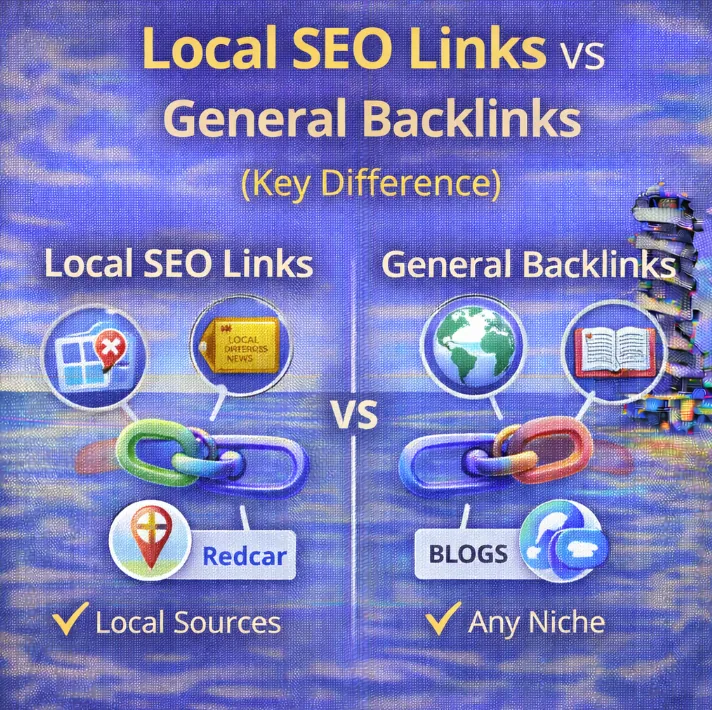
The Key Difference: Authority vs. Relevance
If we had to boil this down to a single concept, it would be this:
General Backlinks build Authority.
Local SEO Links build Relevance.
Imagine you are running for Mayor of Redcar.
- General Backlink: The Prime Minister says you are a “good person.” This is great. It makes you look important and trustworthy on a national scale.
- Local SEO Link: The head of the Redcar Lifeboat Station says you are “great for the town.”
Which endorsement is more likely to get local people to vote for you? The local one.
For a local business, you need a mix of both, but Relevance usually wins the battle for local rankings. You can have a website with lower overall “authority” than a big national competitor, but if you have better local links, you can still beat them in the local map results.
Why Redcar Businesses Often Get This Wrong
Many business owners get obsessed with metrics that don’t matter. They use free SEO tools that tell them their “Domain Rating” is low, so they go out and buy cheap links from random blogs in India or the USA.
This is a disaster waiting to happen.
Google is smart. If you are a carpet fitter in Dormanstown, and you suddenly get 500 links from Russian forum sites, Google knows you are trying to cheat. This can lead to penalties that tank your traffic.
On the flip side, some businesses ignore links altogether. They think having a nice website is enough. It isn’t. You need to actively build these connections to prove you are the go-to authority in the area.
How to Build a Local Link Strategy (That Actually Works)
So, how do you actually get these local links? You don’t need to be a technical wizard. You just need to be a bit savvy and willing to network.
Here is a step-by-step guide to building a link profile that will help you dominate the Redcar search results.
1. Master Your Citations
Local citations are the foundation of local SEO. A citation is simply a mention of your business name, address, and phone number (NAP) on another website.
Most citations also include a link back to your website.
Action Plan:
- Get listed on major UK directories like Yell, Thomson Local, and Scoot.
- Look for niche directories. If you are a mechanic, look for “UK Garage Directories.”
- Crucial Step: Ensure your NAP consistency is perfect. Your name, address, and phone number must be identical on every single listing. Google hates conflicting information.
2. Leverage Local Sponsorships
This is one of the easiest ways to get a high-quality local link. Local sports teams, charities, and events are always looking for support.
Action Plan:
- Sponsor a local youth football team in Redcar. In exchange, ask for your logo and a link on their “Sponsors” page.
- Support a local charity event.
- Sponsor a category in a local business award.
These links are gold dust because they usually come from .org or reliable local domains that Google trusts implicitly.
3. Digital PR and Local Press
Getting in the news is fantastic for your brand, but it is also great for your SEO.
Action Plan:
- Have you done something newsworthy? Maybe you are a bakery that has just invented a “Teesside Lemon Top Doughnut.”
- Send a press release to papers like The Gazette or The Northern Echo.
- If they write about you, politely ask them to include a link to your website so readers can find you.
Even if the link is a “no-follow” (which means it doesn’t pass full authority), the traffic and the local signal it sends are still incredibly valuable.
4. Partner with Other Local Businesses
You likely already have relationships with other business owners in Redcar. Use them.
Action Plan:
- The Supplier Strategy: If you run a cafe and you buy your beans from a local roaster, ask them to feature you on their “Wholesale Partners” page with a link.
- The Neighbour Strategy: If you are an interior designer, partner with a local painter. Write a blog post for their site about “Colour Trends in 2024,” and have them link back to your site. This is a classic example of guest posting done right.
5. Create “Localised Content” that Earns Links
People link to things that are useful. Instead of just writing about your services, write about your area.
Action Plan:
- Create a guide on your website: “The Best Wedding Venues in Redcar & Cleveland.”
- If you are a wedding photographer, this makes sense. You then email all the venues you mentioned and say, “Hey, I featured you in my top 10 guide! Feel free to share it.”
- Often, they will share it on their social media or link to it from their own “Press” section.
This is the power of localised content. It positions you as a local expert.
What About Anchor Text?
When you are building these links, you need to pay attention to anchor text. This is the clickable text in a hyperlink.
For General Backlinks: You often want “branded” anchor text (e.g., “Smith’s Bakery”) to build trust.
For Local SEO Links: You can be a bit more specific. Having a link that says “best bakery in Redcar” pointing to your site helps Google understand exactly what you do and where you do it. However, don’t overdo this. If every single link says exactly the same keyword, it looks suspicious. Keep it natural.
The Role of Internal Linking
We have talked a lot about links coming in to your site, but don’t forget the links on your site.
Internal linking is how you spread the value of those backlinks around your website.
Imagine you get a great backlink to your Homepage from the Redcar Council website. That gives your Homepage a boost. But you really want your “Services” page to rank.
By linking from your Homepage to your Services page, you pass some of that “link juice” along. You are telling Google, “This page is important too.”
Pro Tip: Use descriptive anchor text for your internal links. Don’t just click “read more.” Use text like “view our roofing services.”
Using “HARO” for General Links (With a Local Twist)
HARO stands for Help A Reporter Out. It is a platform where journalists ask for expert quotes. This is a HARO strategy.
While this is usually used for general backlinks, you can use it to build your topical authority.
If you are a financial advisor in Redcar, and you get quoted in The Telegraph about pension changes, that is a massive trust signal. You can then put a “As Featured In The Telegraph” badge on your website. This increases your conversion rate for local customers who see you as a national expert who just happens to be local.
The “Map Pack” Factor
Why do we do all this? For most local businesses, the holy grail is the Google Map Pack (the map with three business listings that appears at the top of search results).
Your ranking in this pack is heavily influenced by your Google Business Profile.
However, organic links play a huge role here too. If your website has strong local links, it boosts your Map Pack ranking. The two work together. You cannot view your website SEO and your Map SEO as separate silos. They are part of the same ecosystem.
Common Mistakes to Avoid
In the rush to get links, it is easy to make mistakes that can hurt your rankings.
- Buying Links: Just don’t do it. If a site emails you offering “500 backlinks for $10,” run away. These are usually spammy sites that Google has already flagged.
- Irrelevant Directories: Being listed in a directory for “New York Real Estate” when you are a florist in Redcar is confusing to Google. Stick to UK and industry-specific directories.
- Ignoring Competitors: Look at who is ranking #1 for your keywords. Put their URL into a backlink checker. Where are they getting their links from? Can you get a link there too? This is basic competitor analysis.
- Keyword Stuffing: Don’t force keywords into your anchor text where they don’t fit. Readability comes first.
How to Audit Your Current Link Profile
Before you start building, you need to know where you stand.
You can use various tools to check your backlinks. Look for:
- Toxic Links: Links from gambling or adult sites that you didn’t ask for. You might need to disavow these.
- Broken Links: Links that point to pages on your site that no longer exist (404 errors). You should set up 301 redirects to point these to a working page so you don’t lose that value.
The Verdict: Quality Over Quantity
In the debate of Local vs. General, the answer for a Redcar business is clear.
You need a foundation of general links to prove you are a real business, but you need a focused strategy of Local SEO links to dominate your market.
One link from a highly relevant local source (like the Redcar & Cleveland website or a popular Teesside blog) is worth 100 links from random, unconnected blogs.
Focus on building relationships in the real world, and the digital links will often follow.
Next Steps for Your Redcar Business
SEO isn’t a dark art; it is just a series of logical steps.
- Check your foundations: Is your website technically sound? Is your content good?
- Claim your profiles: Get your Google Business Profile and local citations sorted.
- Start networking: Look for those local sponsorship and partnership opportunities.
- Create content: Give people a reason to link to you.
If you are feeling overwhelmed, remember that you don’t have to do it all at once. SEO is a marathon, not a sprint. Start with the local quick wins, build your presence in the community, and watch your rankings climb.
