




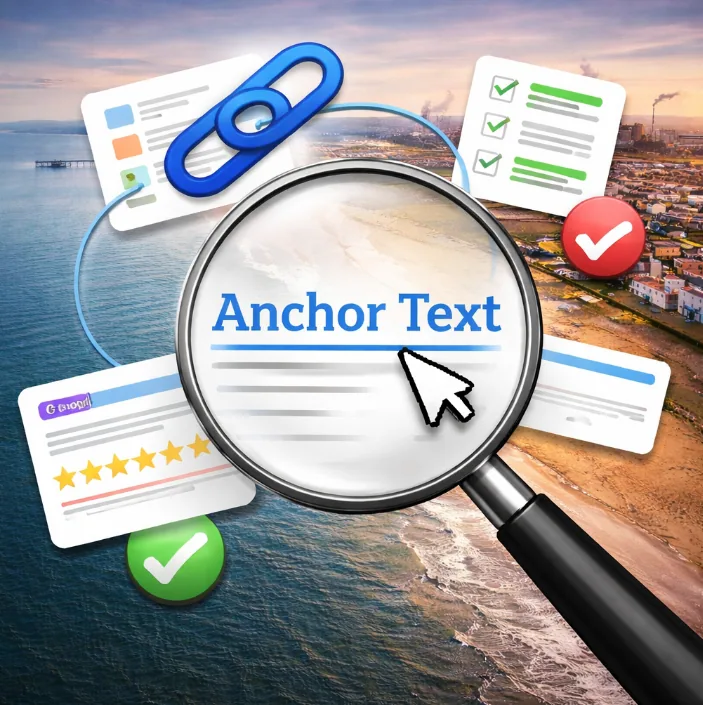
Anchor text is the clickable text inside a link.
That’s it.
Simple concept – but don’t let that fool you.
Anchor text is one of the most quietly influential parts of SEO. It affects how search engines understand your pages, how visitors move around your site, and which pages actually end up doing the work (bring in leads or customers) for your business.
Used well, it supports visibility, relevance, and conversions.
Ignored, it becomes a missed opportunity across your entire website.
This guide covers everything you need to know to use anchor text properly – without jargon, tricks, or guesswork.
Ready? Let’s jump in:
What Is Anchor Text?
Anchor text is the visible, clickable part of a hyperlink.
It tells:
- Search engines what the linked page is about
- Users what they should expect when they click
Done properly, it adds clarity for both.
Here’s a simple example:
Good: Website design services in Redcar
Not so helpful: Click here
In the first example, the link clearly describes the destination.
In the second, it provides no real context at all.
Search engines don’t “see” links the way people do – they rely heavily on the words used around and inside them to understand how pages relate to each other.
That’s why anchor text matters more than most people realise.
Why Anchor Text Matters for Local SEO
Anchor text helps connect content ideas across your site.
When multiple pages link to a service or location page using relevant, natural wording, search engines start to associate that page with those topics.
For a local business, this helps reinforce:
- What you offer
- Where you offer it
- Which pages matter most
It’s not about stuffing keywords. It’s about clarity and consistency.
Every internal link is a small signal. Over time, those signals (just like in general SEO) add up.
The Main Types of Anchor Text (And When to Use Them)
Not all anchor text serves the same purpose. The key is knowing where each type makes sense.
Exact Match Anchor Text
This is when the anchor text exactly matches the main topic or keyword of the page being linked to.
Examples:
- Accountant in Redcar
- Kitchen fitting services
These are useful – especially for core service pages – but should be used carefully.
If every link uses the exact same wording, it can start to look unnatural. Variety matters.
Think of exact match anchors as precise tools, not defaults.
Partial Match Anchor Text
Partial match anchor text includes the main topic as part of a longer, more natural phrase.
Examples:
- Looking for reliable accounting services in Redcar?
- Learn more about our kitchen fitting process
This is usually the most natural and flexible option, especially in blog posts, guides, and FAQs.
For most websites, this should make up the majority of internal links.
Branded Anchor Text
This uses your business name as the anchor.
Examples:
- Redcar Web Co
- Smith & Co Accountants
Branded anchors are clean, safe, and useful for:
- Homepage links
- Citations
- Mentions on other websites
- Directory listings
They help reinforce brand recognition without pushing keywords.
Naked URL Anchor Text
This is when the URL itself is used as the anchor.
Example: https://www.example.co.uk/
It’s occasionally fine for citations or references, but on your own website it adds little value.
Where possible, descriptive anchor text is more helpful for both users and search engines.
Generic Anchor Text
Examples include:
- Click here
- Read more
- Learn more
These don’t harm SEO, but they don’t help much either.
If you use them, the surrounding text should clearly explain what the link leads to.
For example: “Learn more about our commercial cleaning services in Redcar.”
The context does the work, even if the anchor itself is generic.
Internal Links vs External Links
Anchor text behaves slightly differently depending on where the link lives.
Internal Links (Within Your Website)
These are links you fully control.
They help:
- Shape your site structure
- Distribute authority
- Guide visitors toward important pages
Search engines pay close attention to internal anchor text because it reflects how you describe your own pages.
This makes internal linking one of the most reliable, low-risk ways to reinforce relevance.
External Links (Links From Other Websites)
These are often called backlinks.
You don’t always control the anchor text here, but when other websites link to you using relevant or branded anchors, it helps build trust and authority.
Local directories, partners, suppliers, and press mentions all contribute to this.
How Anchor Text Influences Rankings (In Practice)
Anchor text won’t fix weak content or replace good fundamentals – but it does amplify what’s already there.
Internally: Reinforcing Meaning
When multiple pages link to the same destination using sensible, varied anchor text, search engines gain confidence in what that page represents.
For example, a blog article might naturally link to a service page with wording that reflects real-world language – helping both readers and search engines make the connection.
Over time, this consistency supports stronger visibility.
Externally: Reinforcing Trust
External links carry more weight, but they also need to look natural.
A mix of:
- Branded anchors
- Partial matches
- Plain references
Is far healthier than repetition.
The goal isn’t control – it’s credibility.
Common Anchor Text Questions (Answered Clearly)
“Should anchor text always include keywords?”
No. It should describe the destination naturally. Keywords are helpful when they fit, not when they’re forced.
“Can anchor text hurt SEO?”
Only when it’s repetitive, manipulative, or misleading. Clarity and variety are what matter.
How often should I link to the same page?
As often as it makes sense. Relevance matters more than frequency.
Do menu links count?
Yes – but contextual links within content usually carry more meaning/SEO weight/juice.
Does anchor text matter for local pages?
Yes. It helps reinforce location relevance when used naturally.
Anchor Text Is Foundational, Not Flashy
Anchor text isn’t exciting. It’s rarely visible to anyone reviewing a site.
But it quietly supports:
- Search visibility
- Page relationships
- How authority flows across your website
Most sites only think about it accidentally.
Understanding it simply means fewer missed opportunities as your site grows.
It’s one of those background tasks that rarely gets attention, but makes everything else work better.
