




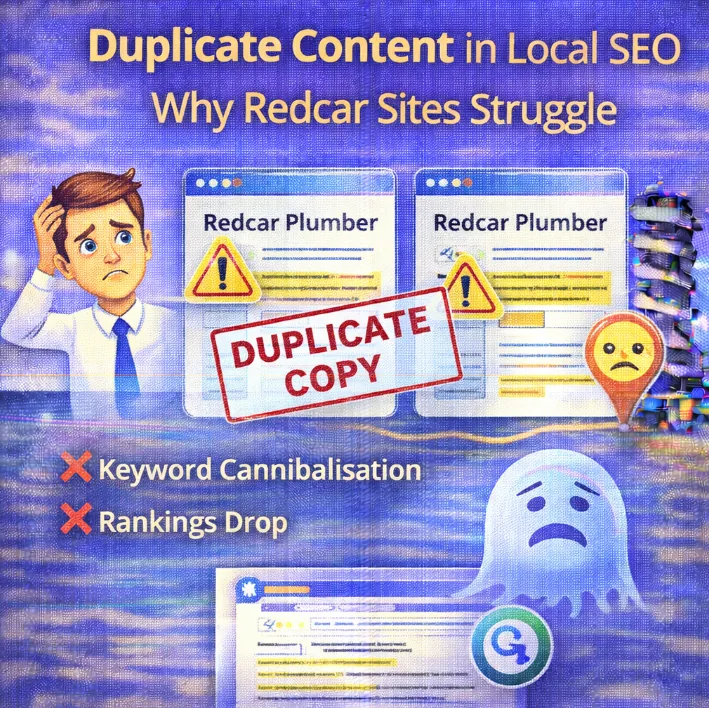
You have built a stunning website. It looks crisp, the images are sharp, and you are ready to welcome customers from all over Redcar and Cleveland. But when you check Google, your competitors are sitting pretty at the top while you are stuck on page four.
It is frustrating. It keeps business owners awake at night.
One of the most common, silent killers of local rankings is duplicate content. It is an issue that plagues countless businesses in our area, from the high street boutiques to the independent cafes along the Esplanade. You might not even know you are doing it, but Google certainly does.
In this guide, we are going to strip back the jargon and look at exactly what duplicate content is, why it is hurting your visibility in Redcar, and the actionable steps you can take to fix it today.
What Exactly Is Duplicate Content?
In the simplest terms, duplicate content refers to substantive blocks of content within or across domains that either completely match other content or are appreciably similar.
Imagine you own a bakery. You bake a specific sourdough loaf. If you wrote a description for that loaf on your website, but then copied that exact same description to your Facebook page, a local directory, and five other product pages… that is duplicate content.
Google wants to provide diversity in its SERPs (Search Engine Results Pages). It rarely shows multiple versions of the same information because that provides a poor user experience. When Google finds multiple versions of the same content, it struggles to decide:
- Which version is the original?
- Which version should rank for the search query?
- Whether to split the “link equity” (ranking power) between the pages or just ignore them all.
For a local business, this confusion often results in your site slipping down the rankings, making it harder for local customers to find you.
The “Redcar Radius” Problem: Why Local Sites Struggle
We see a specific pattern with businesses in Redcar. Because our town is close to other hubs like Saltburn, Marske, and Guisborough, business owners naturally want to rank in all those areas.
Here is the trap.
A local window cleaner might create a page for “Window Cleaning Redcar”. They write 500 words about their service. Then, they create a page for “Window Cleaning Marske” and copy/paste the exact same text, only changing the word “Redcar” to “Marske”.
This is classic “cookie-cutter” content.
To you, it looks like an efficient way to cover your service area local SEO. To Google, it looks like low-quality, spammy manipulation. It tells the search engine that you have nothing unique to say about these different locations.
The Manufacturer Description Trap
Another common issue for Redcar retailers involves e-commerce.
Let’s say you run a hardware store. You sell a specific brand of drill. If you copy the product description directly from the manufacturer’s website, you are using the exact same text as potentially thousands of other hardware stores across the UK.
Why would Google rank your product page above the manufacturer’s own site or a giant like Amazon? They have higher authority. If your content is identical, you fade into the background.
Why Uniqueness Matters for Local Authority
Google places a high value on E-E-A-T (Experience, Expertise, Authoritativeness, and Trustworthiness).
Original content demonstrates expertise. It shows you have taken the time to write about your services or products in your own voice. When you duplicate content, you are essentially telling Google, “I have nothing new to add here.”
If you want to build topical authority in your niche, you need to produce material that provides unique value. This is especially true for local SEO content. A page about plumbing in Redcar should talk about the hard water issues specific to the area or the types of Victorian piping found in the older terraces near the seafront. That is expertise. That is unique.
Identifying the Duplication on Your Site
Before we can fix the problem, we need to find it. You don’t need to be a technical wizard to spot the obvious issues, though a local SEO audit is the most thorough method.
1. Check Your Service Pages
Look at your navigation bar. Do you have separate service pages for very similar offerings? For example, “Commercial Flooring” and “Business Flooring”. If the text on these pages is 90% the same, you have a problem called keyword cannibalisation. You are effectively competing with yourself.
2. Review Your Location Pages
As mentioned earlier, check your location pages local SEO strategy. Open your Redcar page and your Saltburn page side-by-side. If you can swap the city names and the content still makes perfect sense, it is not unique enough.
3. The “About Us” Test
Do you paste your “About Us” text into the footer of every single page on your site? While small snippets are fine, having huge blocks of identical text on every page can dilute the relevance of the page’s main topic.
4. Technical Duplication
Sometimes, the issue isn’t what you wrote, but how your site is built. This involves your URL structure.
- Does your site load on both http:// and https://?
- Does it load on www.yoursite.co.uk and yoursite.co.uk?
If both versions exist without redirecting to one “master” version, Google sees two separate websites with identical content.
The Solution: How to Fix Duplicate Content
Now that we understand the problem, let’s look at how to fix it. This isn’t just about deleting pages; it is about optimising your digital presence to be robust and distinct.
Strategy 1: The Canonisation of Content
This sounds religious, but it is actually technical. Canonical tags are a piece of code that tells Google, “Hey, I know there are a few versions of this page, but this one is the main one.”
If you have a product that fits into two categories (e.g., a “Black Leather Boot” in “Menswear” and “Shoes”), your e-commerce platform might create two URLs.
- site.co.uk/menswear/black-boot
- site.co.uk/shoes/black-boot
Without a canonical tag, these are duplicates. By adding a canonical tag pointing to the version you want to rank, you solve the issue without deleting the user-friendly navigation.
Strategy 2: 301 Redirects
If you find you have old pages that are duplicates of new pages, or you are consolidating three thin pages into one strong page, use 301 redirects. This automatically sends both the user and the search engine from the old URL to the new one, passing on the ranking power.
Strategy 3: Writing Truly Localised Content
This is where the magic happens. This is how you beat the big national chains.
You need to create localised content that actually speaks to the area.
Instead of:
“We offer accountancy services in Redcar. We are professional and reliable.”
Try this:
“Based near the Redcar beacon, our accountancy firm understands the specific challenges facing seasonal tourism businesses and independent retailers on the High Street.”
See the difference? The second example includes local context that a copy-paste job simply cannot match. It signals to Google (and the user) that you are physically here and you know the local market.
Strategy 4: Unique Meta Data
It is not just the body text. You need to ensure your title tags and meta descriptions are unique for every page.
If every page on your site says “Best Plumber in Redcar” in the title tag, Google won’t know which page to rank for that search. Be specific. Use “Emergency Boiler Repair Redcar” for one and “Bathroom Installation Redcar” for another.
Leveraging Content Pillars for Uniqueness
One of the best ways to avoid duplication is to organise your site using content pillars.
A content pillar is a substantial, informative page on a broad topic (like “Home Renovation”). You then have cluster pages linking back to it that cover specific sub-topics (like “Kitchen Fitting,” “Bathroom Tiling,” “Loft Conversions”).
By structuring your content this way, you ensure every page has a distinct purpose. You are not repeating the same general “we do renovations” pitch on every page. Instead, the “Kitchen” page focuses entirely on kitchens – sinks, worktops, plumbing – making it 100% unique from the “Loft” page.
This structure also improves your internal linking, which helps Google crawl your site and understand the relationship between your pages.
Dealing with Google Business Profiles
Duplicate content isn’t just a website issue; it can happen on your Google Business Profile (GBP) too.
While you cannot “duplicate” a profile in the same way, you can confuse Google by having inconsistent information. This is where NAP consistency (Name, Address, Phone Number) is vital.
If your website says “Smith & Sons Joinery” but your GBP says “Smiths Joiners Redcar”, that inconsistency hurts trust.
Furthermore, do not copy-paste your GBP description directly from your website’s “About Us” page. Treat your GBP as a unique entity. Write a description that is punchy and optimised specifically for someone looking at a map listing, not browsing a website.
Also, be careful with GBP categories. Choose the primary category that best describes your business, and use secondary categories for additional services. Don’t try to spam categories that aren’t relevant, as this confuses the algorithm.
Reviews: User-Generated Unique Content
One of the best sources of fresh, unique content comes from your customers. GBP reviews are gold dust.
When a customer writes a review, they often use natural language and keywords you might not have thought of. They might say, “Fixed my leaking radiator in my flat near the stray.”
That is hyper-local, unique content appearing right on your profile. Encouraging reviews not only boosts your social proof but helps you rank for long-tail keywords without you having to write a word.
The Role of Blogs in Fighting Duplication
A blog is your best weapon against stagnation and duplication. It allows you to target specific questions and topics without cluttering your main service pages.
However, avoid the trap of “thin” blogging. Do not write four different blog posts about “Why you need a florist.” They will just compete with each other.
Instead, use keyword research to find distinct questions people are asking.
- “Best flowers for a winter wedding in North Yorkshire”
- “How to care for roses in a coastal garden”
These are unique topics. They add depth to your site. They allow you to capture search intent at different stages of the buying journey.
Tracking Your Success
How do you know if your cleanup efforts are working? You need to track GBP performance and website analytics.
When you remove duplicate content and consolidate your pages, you might see a dip in the number of indexed pages. Do not panic. This is good. You are cutting the dead wood.
Watch your rankings for your main keywords. Watch your organic traffic. As Google starts to understand your site better, you should see those numbers climb. You can also monitor your local citations to ensure external directories aren’t feeding incorrect or duplicate data back to search engines.
Common Myths About Duplicate Content
Let’s bust a few myths before we wrap up.
Myth: Google has a “Duplicate Content Penalty”.
Not exactly. Google doesn’t usually go out of its way to punish you (unless you are scraping content maliciously). It just filters the duplicates out. The “penalty” is simply that your site performs poorly because Google is ignoring half your pages.
Myth: You can’t quote anyone.
Quoting a testimonial or a regulation is fine. As long as the bulk of the page is original, a small quote won’t hurt you.
Myth: I need to rewrite my Terms & Conditions.
No. Google understands that legal pages, privacy policies, and cookie warnings are standard. You won’t get flagged for having a standard T&C page.
Why Quality Trumps Quantity Every Time
In the world of SEO, particularly when competing against other Redcar businesses, quality wins.
It is better to have 10 incredible, unique, highly detailed pages than 100 thin, repetitive ones.
If you are struggling to write unique content, go back to basics. Think about your keyword placement. Map out your site structure using keyword mapping to ensure every single page targets a unique term.
If you are a photographer, don’t just have a “Gallery” page. Have a “Coastal Photography Redcar” page and a “Wedding Photography Cleveland” page. Describe the photos. Talk about the lighting at the specific venues. Make it real.
When to Use Paid Ads
Sometimes, while you are fixing your organic SEO and rewriting content, you need immediate visibility. This is where Google Ads can help bridge the gap.
While PPC vs SEO is a constant debate, the truth is they work best together. You can use ads to drive traffic to your newly optimised, unique pages to see how well they convert before waiting for the organic rankings to catch up.
Final Thoughts: Be Authentically You
The easiest way to avoid duplicate content is to be authentic.
Your business in Redcar is unique. You have your own story, your own team, and your own way of doing things. Your website should reflect that.
Don’t copy the industry leader. Don’t copy the manufacturer. And certainly don’t copy yourself.
Invest the time in writing copy that connects. Use header tags to structure your unique arguments. Build backlinks to your strongest, most original resources.
By cleaning up duplicate content, you are clearing the fog for Google. You are saying, “Here I am. This is what I do. And this is why I am the best choice in Redcar.”
It takes effort, but the reward – a top spot on Google and a phone that won’t stop ringing – is well worth it.
