




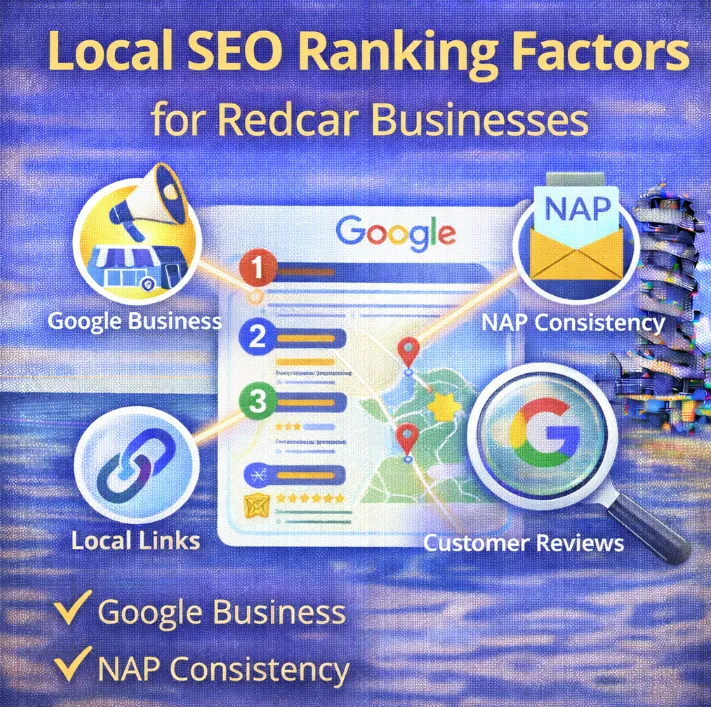
If you run a business in Redcar, you know that word of mouth travels fast. Whether it’s a recommendation for a plumber shared over a pint or a tip about the best lemon top on the Esplanade, locals trust locals. But in today’s digital world, that conversation has moved online. When someone in TS10 needs a service, they don’t just ask their neighbour; they ask Google.
You might be wondering why your competitor down the road is showing up first when you search for your own services, while your website is nowhere to be found. It feels a bit like they’ve set up shop right at the entrance of the Beacon while you’re tucked away in a back alley.
The secret isn’t magic. It is understanding the specific signals Google uses to decide who gets that prime real estate. We call these ranking factors.
And when we talk about local visibility, we are actually fighting a war on two fronts: the Local Map Pack (that block of three maps at the top) and the Organic results (the traditional blue links below).
Let’s dive deep into what actually moves the needle for businesses in our area.
The Two Distinct Playgrounds: Maps vs Organic
Before we start tweaking your website, it is crucial to understand that Google treats the Map Pack and the Organic search results as two different games. They have different rules, different referees, and different winning strategies.
The Map Pack is highly dependent on your Google Business Profile and where you are physically located. It is designed for the “I need it now” searcher.
Organic Results are more about your website’s authority, the quality of your content, and how well you answer the user’s question.
While they are distinct, they do influence each other. A strong website helps your Map ranking, and a popular Map profile drives traffic to your site. Here is the breakdown of what you need to focus on to dominate both in Redcar.
Part 1: Dominating the Redcar Map Pack
For most local businesses, specifically trades, hospitality, and retail, the Map Pack is where the money is. If you are not in those top three spots, you are practically invisible to mobile users. Here are the heavy hitters for ranking there.
1. Your Google Business Profile (The Holy Grail)
Nothing – and I mean NOTHING – beats a well-optimised profile. This is your digital storefront. If you haven’t claimed it yet, stop reading this and go do it. If you have, you need to ensure it is working for you, not just sitting there gathering digital dust.
Categories are King
The primary category you choose is the single biggest factor in where you rank. If you are a “Pizza Takeaway” but you list yourself as an “Italian Restaurant”, you might miss out on the Friday night crowd looking for a quick bite. You can add secondary categories, so use them to fill out your service offerings, but nail that primary one. Check out our guide on GBP categories to get this spot on.
The Name Game
Your business name needs to be your actual business name. It is tempting to stuff keywords in there like “Redcar Plumbers & Heating Best Boiler Repair”, but Google hates spam. Stick to your registered trading name to avoid a suspension.
2. Physical Address and Proximity
This is the one factor you cannot really control, but you need to understand it. Google wants to show the closest relevant result to the searcher. If someone searches for “coffee shop” while standing near the boating lake, Google will prioritise cafes in that immediate radius.
However, you can expand your reach. By building stronger authority through other factors we will discuss, you can convince Google that your business is worth travelling for, extending your radius further into Marske or Saltburn. For more on how address impacts ranking, look at our insights on physical address in GBP.
3. Review Signals (Quantity and Velocity)
We all look at star ratings. A 4.9-star rating looks a lot better than a 3.5. But Google isn’t just counting stars. It is looking at:
- Review Quantity: How many do you have?
- Review Velocity: Are you getting them consistently, or did you get 20 in 2019 and none since?
- Review Text: Are customers using keywords? “Best fish and chips in Redcar” in a review carries a lot of weight.
You need a strategy to get GBP reviews regularly. Don’t be shy about asking happy customers.
4. Consistency is Key (NAP)
NAP stands for Name, Address, and Phone Number. Google acts like a confused detective. If your website says you are at 12 High Street, but your Facebook says 12a High Street, and Yell says 14 High Street, Google gets nervous. It loses trust in your data.
You need to ensure your NAP consistency is watertight across the web. This includes directory listings (citations) like Thompson Local, Yell, and industry-specific sites. If you have moved premises recently, you need to audit this immediately.
Part 2: Winning the Organic Blue Links
While the maps are great for “near me” searches, the organic results are where you build long-term trust and capture people doing research. This is where your website needs to shine.
5. On-Page Keyword Optimisation
You cannot rank for terms you don’t use. It sounds simple, but you would be amazed how many Redcar businesses have homepages that say “Welcome to our site” but never mention “Roofing Services in Redcar”.
You need to identify what people are actually typing into Google. This is called keyword research. Once you know the terms (e.g., “emergency electrician Redcar”), you need to place them strategically in your:
- Title Tags: The headline that shows up in Google results.
- Header Tags: The H1, H2, and H3 headings on your page.
- Body Content: Naturally woven into your sentences.
Be careful not to overdo it. Google is smart enough to spot keyword stuffing. Read up on keyword placement to find the balance.
6. Localised Content
You can’t just copy-paste a generic service page and expect to rank locally. You need to prove to Google that you are part of the local fabric.
This means creating localised content. Mention local landmarks, nearby areas you serve (like Dormanstown or Kirkleatham), and local events. Instead of just a page about “Boiler Repair”, why not discuss “Hard Water Problems in Redcar and How They Affect Your Boiler”? This shows relevance.
If you serve multiple areas, consider creating dedicated location pages for local SEO. Just ensure they aren’t carbon copies of each other, or you will run into duplicate content issues which can hurt your rankings.
7. Link Building (The Popularity Contest)
In the eyes of Google, a link from another website to yours is a vote of confidence. If the Redcar & Cleveland Council or a local news outlet links to your site, that is a massive thumbs up. It tells Google you are a legitimate, trusted entity.
These are called backlinks. But not all links are created equal. A link from a local charity you sponsor is worth far more than a dodgy link from a directory in Russia.
- Local Sponsorships: Sponsor a local football team? Ask for a link on their site.
- Local News: Have a story to tell? Reach out to local press.
- Guest Posting: Write an article for a local business partner in exchange for a link.
Don’t forget internal linking too. This is linking from one page of your site to another. It helps Google crawl your site and understand which pages are most important.
8. Technical Health and User Experience
You could have the best content in the world, but if your website takes ten seconds to load, users will bounce. Google hates sending users to frustrating websites.
- Mobile Friendliness: Most local searches happen on phones. If your site isn’t responsive, you are dead in the water.
- Speed: Compress your images and clean up your code.
- Security: Ensure you have an SSL certificate (the little padlock in the browser bar).
- URL Structure: Keep your web addresses clean and descriptive.
Check for broken links or pages that have moved without 301 redirects. These technical hiccups act like roadblocks for Google’s crawlers.
Part 3: Advanced Tactics for the Competitive Edge
Okay, so you have done the basics. Your profile is live, your keywords are on the page, and your site loads fast. How do you push past the competitors who are also doing the basics?
9. Behavioural Signals
Google watches how people interact with your listing.
- Click-Through Rate (CTR): Do people click your link when they see it? A compelling meta description can help here. It acts as your ad copy in the search results.
- Dwell Time: Do they stay on your site to read, or do they hit the back button immediately?
- Click-to-Call: On mobile, how many people are tapping that “Call” button?
You can improve these by making your content engaging and ensuring your search intent alignment is correct. If someone searches “emergency plumber price”, don’t send them to a generic “About Us” page. Send them to a pricing page.
10. E-E-A-T (Experience, Expertise, Authoritativeness, Trustworthiness)
Google wants to rank experts. If you offer financial advice or medical services, this is doubly important. You need to demonstrate E-E-A-T.
- Author Bios: Show who is writing the content. Are they qualified?
- Case Studies: Show your work.
- Accreditations: Display your Gas Safe register, FENSA, or other industry badges prominently.
Building topical authority helps here too. Don’t just write one post about windows. Write about double glazing, sash windows, energy efficiency, and condensation. Cover the topic so thoroughly that Google sees you as the ultimate resource.
11. Managing Multiple Services
If you offer different services, do not squash them all onto the homepage. You need dedicated service pages. A customer looking for “gutter cleaning” might not click a result that talks mostly about “roofing”.
By splitting these out, you can target specific keywords for each service. However, watch out for keyword cannibalisation, where two of your pages fight for the same keyword, confusing Google and lowering the rank of both.
Why You Might Not Be Ranking Yet
It can be frustrating. You feel like you are doing everything right, but the phone isn’t ringing. Here are common pitfalls we see in Redcar businesses.
The “Set and Forget” Mentality
SEO isn’t a one-time job. It is a gym membership. You have to keep turning up. Your competitors are likely adding new content, getting new reviews, and updating their photos. If you stop, you drop.
Ignoring the Data
Are you tracking what works? You should be using tools to track GBP performance and Google Analytics for your website. If you don’t know where your traffic is coming from, you can’t double down on what works.
Poor Description Writing
Your GBP description isn’t a place to stuff keywords. It is a sales pitch. Use it to convert lookers into bookers.
Lack of Local Citations
We mentioned NAP earlier, but local citations are the bread and butter of trust. If you haven’t manually checked the big directories, there is likely an error somewhere holding you back.
The Role of Content in Local Rankings
“Content is King” is a cliché, but it is true. But for local businesses, it is specifically helpful content that rules.
Answering Questions
Think about the questions customers ask you on the phone.
“How much does a boiler service cost?”
“Do you charge a call-out fee in Marske?”
“How long does it take to replace a windscreen?”
Turn these into blog posts or FAQ sections. This is using NLP (Natural Language Processing) principles. Google creates connections between questions and answers. If you provide the best answer, you rank.
Content Pillars
Think of your site as a library. You want sections (pillars) that cover broad topics. Underneath those, you have specific articles (clusters). This structure helps Google understand your expertise. Check out our guide on content pillars to see how to structure this.
PPC vs SEO: Do You Need Both?
We often get asked about PPC vs SEO.
“Should I just pay for Google Ads?”
Google Ads are great for instant results. You pay, you appear. But the second you stop paying, you disappear. SEO is an investment in an asset you own. It takes longer – read our article on how long local SEO takes – but the return on investment over time is usually much higher.
Ideally, you use both. PPC keeps the leads coming in while you build your SEO foundation.
Getting Started: Your Redcar SEO Checklist
If your head is spinning, don’t worry. Here is a simple checklist to get you moving today.
- Audit Your Current Status: You can’t improve what you don’t measure. A local SEO audit will show you where the holes are in your bucket.
- Claim and Polish Your GBP: Fill in every single field. Add photos of your team, your van, and your work.
- Check Your NAP: Google your business name. Fix any address or phone number mismatch you see.
- Create Location Pages: If you serve Guisborough and Saltburn, make pages for them.
- Ask for Reviews: Send a text to your last five happy customers today.
- Start Writing: Commit to one blog post a month about a local job you have done.
Ranking in Redcar isn’t about tricking the system. It is about being the most relevant, trusted, and authoritative answer to your neighbour’s question. It takes work, but the reward is a business that grows sustainably, right here in our community.
