




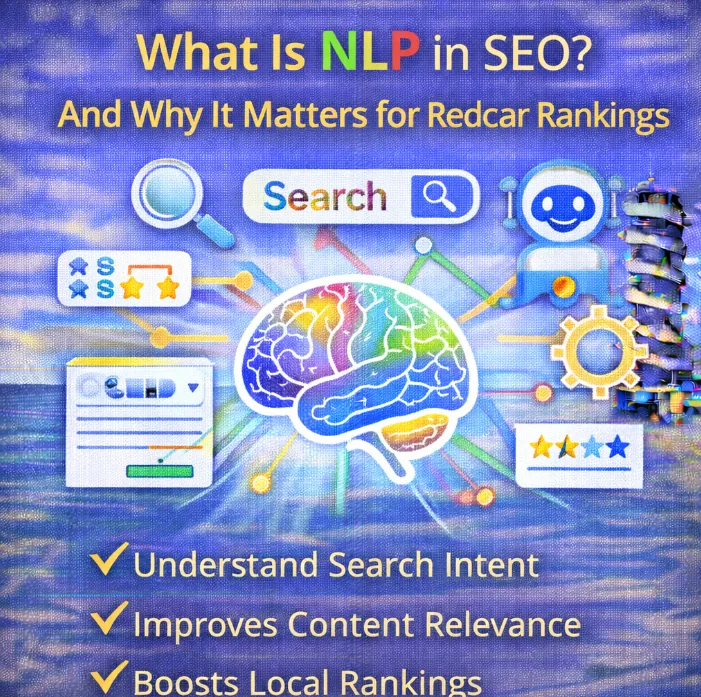
If you have been reading up on digital marketing lately, you might have stumbled across the acronym NLP. It sounds like something out of a sci-fi movie or a university linguistics lecture, doesn’t it?
But here is the truth: NLP (Natural Language Processing) is quietly revolutionising how Google understands your website.
For business owners right here in Redcar, understanding this concept is not just about being tech-savvy. It is about survival in the local search results. If you want your bakery on the High Street or your plumbing van to be the first thing people see when they search, you need to know how Google reads.
In this guide, we are going to break down exactly what NLP is, why it matters for your Local SEO Audit, and how you can use it to climb the rankings.
The Basics: What on Earth Is NLP?
Let’s strip away the jargon. NLP stands for Natural Language Processing. It is a branch of artificial intelligence that helps computers understand, interpret, and manipulate human language.
In the old days of SEO (we are talking five or ten years ago), Google was a bit like a parrot. If you wanted to rank for “best plumber Redcar,” you just had to repeat “best plumber Redcar” enough times on your page. It was robotic. It was clunky. And frankly, it made for terrible reading.
Today, Google is much smarter. Thanks to NLP, Google doesn’t just look for specific keywords. It reads your content to understand the context, the sentiment, and the intent behind the words. It tries to understand your content the way a human would.
The BERT and MUM Updates
You don’t need to memorise these acronyms, but you should know they exist. Google introduced systems like BERT (Bidirectional Encoder Representations from Transformers) and later MUM (Multitask Unified Model).
These are the engines behind the NLP revolution. They allow the search engine to look at the words before and after a keyword to understand the full meaning of a sentence.
For example, the word “bank” means something very different in “bank of the river” versus “bank account.” NLP helps Google figure out which one you are talking about so it can serve the right result to the user.
Why Should a Redcar Business Care About NLP?
You might be thinking, “This sounds great for Wikipedia, but I just sell fish and chips on the Esplanade. Why does this matter to me?”
It matters because Google is getting better at understanding local search intent.
When someone in Redcar searches for “coffee,” they are not looking for the Wikipedia history of coffee beans. They are looking for a hot cup of java nearby. Google knows this thanks to NLP and search intent analysis.
If your website content speaks naturally, covers the topic comprehensively, and uses local language, Google connects the dots. It realises you are the most relevant answer to that user’s problem.
Here is why NLP is a game-changer for your rankings:
- It kills keyword stuffing. You can focus on writing for humans, not bots.
- It rewards authority. Google can tell if you truly know your stuff or if you are just fluffing up a page.
- It boosts voice search. When people ask Siri or Alexa a question, they speak naturally. NLP helps Google match those conversational queries to your content.
How Google Uses NLP to Analyse Your Content
To get your head around this, we need to look at three core elements of NLP in SEO: Entities, Salience, and Sentiment.
1. Entities: The “Things” in Your Content
In the eyes of Google, an “entity” is a thing. It can be a person, a place, a brand, or a concept.
If you are writing about “Redcar Beacon,” Google identifies that as a specific landmark entity. If you mention “lemon top ice cream,” it identifies that as a food entity associated with this specific region.
Google keeps a massive database of these entities (the Knowledge Graph). When your content connects these entities logically, Google trusts you more.
Actionable Tip: Don’t just talk about “services.” Talk about specific locations, local landmarks, and recognized industry terms. This helps build your Topical Authority.
2. Salience: How Important Is It?
Salience is a fancy score Google gives to entities to decide what your page is really about.
Let’s say you write a blog post. You mention “Redcar” ten times, but you mention “cheap shoes” twenty times.
Google might decide the salience of “shoes” is higher than “Redcar,” meaning it thinks your page is about shoes, not the location.
If you want to rank for “Redcar roofing,” you need to make sure both the service and the location have high salience in your text without spamming.
3. Sentiment: Is It Positive or Negative?
Google can now tell if you are being helpful or critical. While this affects reviews massively (check your GBP Reviews), it also impacts standard content. Google generally prefers to rank content that provides a positive, helpful solution to a user’s query.
How to Optimise Your Content for NLP (Without Being a Coder)
You don’t need a degree in computer science to use NLP to your advantage. You just need to change how you approach your content creation. Here is a step-by-step guide for local businesses.
Write Like You Talk (But Better)
The biggest win with NLP is that you can stop writing like a robot. Forget about stuffing exact match keywords into every sentence.
Instead, write naturally. If you are explaining how to fix a boiler, explain it exactly how you would to a customer standing in front of you. Use natural phrasing, questions, and answers.
This helps you capture “long-tail” queries – those specific, conversational questions people type into Google.
Structure Is Everything
Google’s AI loves structure. It helps the “bot” digest information quickly.
- Use clear Header Tags (H1, H2, H3) to break up your points.
- Use bullet points for lists.
- Keep paragraphs short and punchy.
When you structure your content well, you make it easy for NLP algorithms to identify the entities and the hierarchy of information on your page.
Answer the Questions People Are Actually Asking
One of the best ways to align with NLP is to directly answer questions.
Think about the FAQs you get every day. “How much does a haircut cost in Redcar?” “Do you deliver to Marske?” “What is the best time to book a table?”
Create content that asks these questions in a header and answers them immediately in the text below. This is prime fodder for Google’s “Featured Snippets” – those answer boxes at the top of the search results.
Use Related Words (LSI Keywords)
This is crucial. Keyword Placement still matters, but context matters more.
If you are a florist, don’t just say “flowers” fifty times. Use related words that belong in the same “cloud” of meaning:
- Bouquet
- Arrangement
- Roses
- Delivery
- Wedding
- Sympathy
- Petals
- Vase
This helps Google’s NLP confirm that your page is comprehensive and relevant to the topic of floristry.
The Role of Your Google Business Profile
NLP isn’t just for your website pages. It plays a huge role in your Google Business Profile (formerly Google My Business).
Google analyses the text in your reviews and your business description.
If customers keep mentioning “great fish and chips” and “friendly staff” in your reviews, NLP picks up on these sentiments and entities. The next time someone searches “friendly fish and chips Redcar,” you are more likely to show up.
Pro Tip: In your GBP Description, write naturally about what you do and where you are. Mention local landmarks or neighbourhoods to strengthen your local relevance.
Tools to Help You Master NLP
You can guess what Google wants, or you can use data. There are tools out there that simulate how Google’s NLP reads your content.
Tools like Surfer SEO, Frase, or MarketMuse analyse top-ranking pages and tell you which entities and terms you are missing. They might say, “Hey, your competitors are all talking about ‘boiler pressure’ and you haven’t mentioned it once.”
By filling these gaps, you make your content more semantically complete.
However, if you are on a budget, you can use Google itself.
Look at the “People Also Ask” section and the “Related Searches” at the bottom of the page. These give you a massive clue as to what Google considers semantically related to your main topic.
Common Mistakes to Avoid
Even with the best intentions, it is easy to trip up. Here is what to watch out for.
1. Keyword Cannibalisation
This happens when you have two pages on your site trying to rank for the same thing. Because NLP looks at the meaning of the page, not just the keywords, Google might get confused about which page is the authority.
You need clear Keyword Mapping to ensure every page has a distinct purpose.
2. Fluff Content
NLP is good at spotting waffle. If you write 500 words but only say one thing, Google knows. It measures “information gain.”
If your page doesn’t add anything new to the conversation compared to what is already out there, you will struggle to rank. Make sure your Content Pillars are robust and full of genuine insight.
3. Ignoring E-E-A-T
Experience, Expertise, Authoritativeness, and Trustworthiness (E-E-A-T). NLP helps Google evaluate this.
If your content is full of grammatical errors, factual inaccuracies, or makes wild claims without backing them up, the algorithm will downgrade your trust score. Always write with accuracy and authority.
Connecting NLP to Your Local SEO Strategy
So, how do we tie this all together for a Redcar business?
It comes down to creating Localised Content that speaks the language of your customer and the language of the location.
Don’t just write a generic page about “Building Services.” Write a page that discusses “Heritage brickwork restoration in Redcar and Saltburn.” Mention the specific types of stone used in local housing. Discuss the challenges of coastal weather on local roofs.
This level of detail creates a web of entities that screams local relevance to Google’s NLP algorithms.
Is It Time for a Content Audit?
If you have been churning out blog posts for years without thinking about NLP, you might have a lot of content that is effectively invisible to Google.
It might be time to look at your existing pages. Are they thin? Are they stuffed with keywords? Do they lack structure?
A good Local SEO Audit will highlight these issues. You can often get quick wins by simply rewriting old content to be more comprehensive and natural.
Final Thoughts: Don’t Fear the Robot
NLP sounds technical, but it is actually good news for honest business owners. It moves the goalposts away from “who can cheat the system best” to “who provides the best value.”
For businesses in Redcar, this is your opportunity to shine. You know your customers better than any national chain. You know the local slang, the local problems, and the local landmarks.
Use that knowledge. Write comprehensive, helpful, and natural content. If you do that, the algorithms will take care of the rest.If you are staring at a blank screen wondering how to make your website “NLP-friendly,” don’t panic.
