




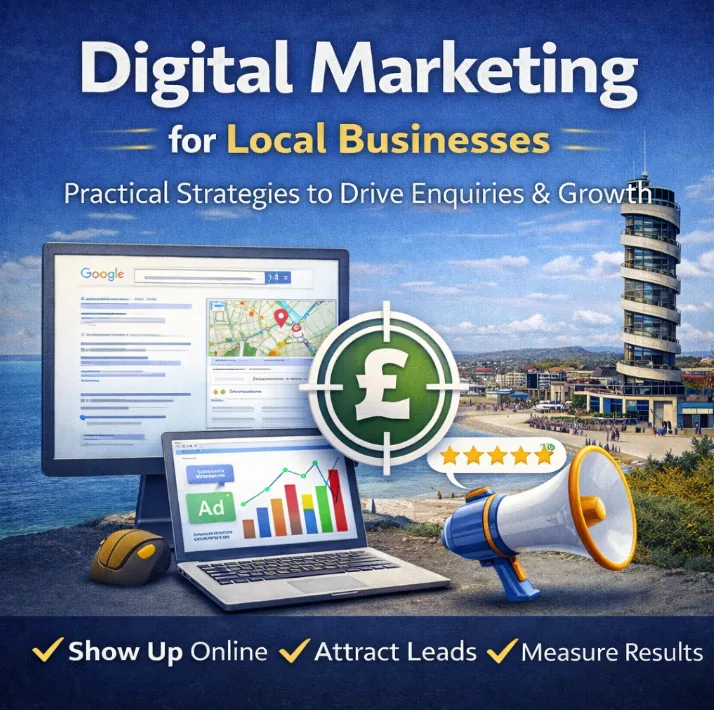
Digital marketing is the backbone of how most local businesses get new customers today.
Word of mouth still matters – but relying on it alone leaves too much to chance. Especially when your competitors are actively showing up on Google, building trust online, and capturing demand the moment someone searches.
The real question isn’t whether you should be marketing online.
It’s where to focus, so every pound you spend actually comes back with interest.
£1 in → £2 out.
At a minimum.
This guide walks through the channels that genuinely matter for local businesses in 2026 – without fluff, trends, or busywork.
Let’s start with a bit of a reality check:
Marketing Has to Pay for Itself (Or It’s Just a Hobby)
Before we jump into it, when it comes to marketing, you need to ask yourself:
“Is it making me money?”
For a local business, digital marketing only works when it produces one of these outcomes:
- more enquiries
- better quality enquiries
- lower cost per lead
- more repeat business and referrals
If you can’t point to a return – even roughly – you’re not “doing marketing”, you’re doing activity.
The goal isn’t to be busy online. It’s to build a system where your marketing spends (time or money) come back with interest.
What Digital Marketing Actually Means for a Local Business
Digital marketing, at its core, is about being visible at the exact moment someone needs what you offer.
That usually happens online.
When someone needs a service urgently or wants to compare options, they don’t leaf through flyers or business cards. They reach for their phone, open Google, and search something like:
- “[service] near me”
- “[service] in Redcar”
- “[problem] help now”
The businesses that show up first – and look trustworthy – get the calls.
Digital marketing is how you make sure that’s you.
Why Digital Marketing Matters More Than Ever
Local customers don’t make decisions in isolation anymore.
Even if someone hears about you offline – through a recommendation, a van they’ve seen, or a neighbour – they almost always check you online before contacting you.
Your website, reviews, and presence on Google act as a trust filter.
A strong digital presence does four things particularly well:
- It puts you in front of people who are already looking
- It attracts higher-quality enquiries
- It builds trust before you ever speak to someone
- It gives you control over what kind of work you attract
And perhaps most importantly: it keeps you competitive in a market where attention is finite.
The Quiet Truth: If You’re Not Visible, Someone Else Is
Local customers don’t stop searching just because you’re good at what you do.
When they need a service, they’ll choose from whoever looks most trustworthy and easiest to contact in the moment.
And this isn’t about “beating everyone” for the ego of it.
It’s about not handing your best jobs to the competitor who simply shows up more often than you do.
The Core Digital Marketing Channels That Actually Matter
There are dozens of marketing tactics floating around online. Most aren’t worth your time.
For local businesses, the strategies below consistently move the needle.
Local SEO: The Long-Term Foundation
Local SEO is about showing up in Google’s local results when someone nearby searches for what you offer.
Done properly, it becomes a compounding asset – traffic and leads coming in without paying for every click.
Local SEO is built on three pillars.
Google Business Profile (GBP)
Your Google Business Profile is often the first thing people see.
It’s what powers the map results and attracts attention fast, especially for urgent or high-intent searches.
A strong GBP includes:
- accurate business details
- real photos
- clear service descriptions
- regular activity
- consistent reviews
When your profile is complete and well maintained, Google is far more confident showing it to local searchers.
Localised Website Pages
Your website still matters – especially service-specific pages.
These pages support your Google Business Profile and catch demand when:
- map results don’t show
- people scroll
- or someone wants more detail before calling
The most effective pages are focused, specific, and written for real people – not just search engines.
They clearly explain:
- what you do
- who it’s for
- where you work
- what happens next
Reviews and Local Authority
Reviews act as social proof for customers and trust signals for Google.
They reduce hesitation, build credibility, and often make the difference between a call and a bounce.
Similarly, local backlinks and citations – mentions of your business on trusted local websites – reinforce your legitimacy within the community.
Together, these signals tell Google:
“This is a real, trusted local business.”
Paid Channels: Faster Traction, Higher Control
SEO takes time. Paid channels can fill the gap.
Google Local Services Ads (LSA)
LSA places you at the very top of the page and charges per lead, not per click.
Used alongside strong SEO, it can dominate visibility – but it still requires:
- good reviews
- fast response times
- consistent management
It’s a powerful accelerator, not a replacement for foundations.
Google Ads (PPC)
Google Ads gives precise control over:
- keywords
- budgets
- timing
- messaging
It can work extremely well, but only when actively managed. Poor setup or neglect quickly turns spend into waste.
If budget is tight, SEO-first is usually the smarter play.
Email Marketing: The Most Underrated Channel
Email isn’t about blasting offers.
It’s about staying visible to people who already trust you.
Simple, useful emails – reminders, tips, updates – keep you top of mind and increase repeat business and referrals.
It’s low-cost, high-return, and often overlooked.
Social Media (Where It Actually Makes Sense)
For most local businesses, social media should be selective.
Facebook remains the most useful platform because it’s local, familiar, and trusted.
Posting occasionally, engaging in community groups, and showing real work builds familiarity – which reinforces trust elsewhere.
You don’t need to be everywhere. You need to be present where it matters.
Make Sure You Measure, So You Know What Works
Marketing without measurement is guesswork.
You should know:
- where enquiries come from
- which channels convert
- what each lead costs
- what actually brings revenue
Tools like Google Analytics help, but the real value is in using the data to make better decisions.
So, What’s the Right Strategy?
For most local businesses, the strongest approach is a simple blend: long-term visibility through local SEO, short-term traction from paid channels, and solid foundations that turn traffic into enquiries.
When those pieces work together, growth becomes predictable instead of reactive. You’re not chasing spikes or patching gaps – you’re building something stable.
Digital marketing doesn’t need to be complicated. It needs to be intentional.
